Headphone power
Does the Røde NTH-100 need an amp?
No, an amp is optional. A phone or laptop gets it loud enough, and only the very biggest peaks come near the limit. It is harder to drive than 68% of the full-size headphones we list, but not by enough to need an amp.
The numbers: a jack leaves 9.8 dB to spare at 100 dB peaks, where we look for 10 dB. Full headroom (110 dB peaks) takes about 1 V (31.3 mW) into 32 ohms; a jack gives about 0.98 V here, because its 30 mW power limit comes first at 32 ohms.
Little reserve from a jackIn plain words
The NTH-100 lands almost exactly on what a phone or laptop gives. Full headroom takes 1 V and about 31 mW, and a jack gives about 1 V and 30 mW. It misses our 10 dB reserve by 0.2 dB, which is nothing. This is what an easy-to-drive full-size headphone looks like in numbers: low impedance, so it needs little voltage, and sensitive enough that the power stays small too.
The terms: Impedance · Sensitivity · Headroom
The Røde NTH-100
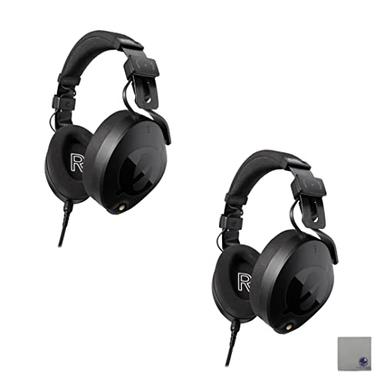
- Driver
- Dynamic
- 40mm
- Back
- Closed-back
- Impedance
- 32 Ω
- Easy load
- Sensitivity
- 110 dB/V
- 95.1 dB/mW at 32 ohms
Figures from the source linked here · How we source figures
The same figures apply to the Røde NTH-100M.
What the Røde NTH-100 needs
| Peaks | Volts | Power | Phone or laptop jack |
|---|---|---|---|
| 95 dB | 0.18 V | 0.99 mW | Enough |
| 100 dB | 0.32 V | 3.13 mW | Little reserve |
| 105 dB | 0.56 V | 9.88 mW | Little reserve |
| 110 dB | 1.00 V | 31.3 mW | Falls short |
| Jack limit | 0.98 V | 30 mW | Reaches about 110 dB peaks |
Peaks are the loudest moments. We look for 10 dB in reserve above 100 dB peaks, from the makers’ own figures.
Where it sits
Harder to drive than 68% of the 790 full-size headphones we have figures for.
Amps that drive the Røde NTH-100
Enough power
Each has at least 10 dB over 100 dB peaks for the NTH-100.
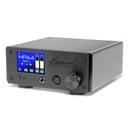 Benchmark HPA4+29.8 dB
6 W into 16 Ω · THX-888 headphone output
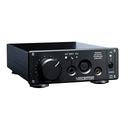 Violectric HPA V222+29.4 dB
2.7 W into 32 Ω · Headphone outputs (balanced and 6.3 mm)
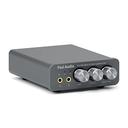 Fosi Audio K5 Pro+22.0 dB
500 mW into 32 Ω · 3.5 mm headphone output · DAC/amp
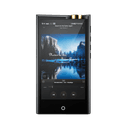 Cayin N7+22.0 dB
500 mW into 32 Ω · 4.4 mm balanced · Player
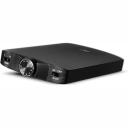 FiiO A3+19.4 dB
270 mW into 32 Ω · 3.5 mm headphone output
 Hidizs AP80 PRO MAX+17.8 dB
190 mW into 32 Ω · 4.4 mm balanced · Player
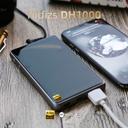 Hidizs DH1000+16.8 dB
150 mW into 32 Ω · 2.5 mm balanced
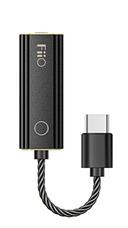 FiiO KA1+11.6 dB
45 mW into 32 Ω · 3.5 mm single-ended · DAC/amp
The line on each bar marks the 10 dB we look for. Bars show dB over 100 dB peaks.
Check any ampQuestions
Can a phone drive the NTH-100?
Yes, with most dongles. Phones mostly play through a USB-C or Lightning dongle now, and 31 of the 32 we have figures for have enough power for the NTH-100, including the FiiO KA1 and the Hidizs Sonata HD DAC Cable 1st Gen. A phone that still has a headphone socket gets it loud enough too, with less in reserve.
How much power does the NTH-100 need?
About 0.32 V (3.13 mW) for 100 dB peaks, and about 1 V (31.3 mW) with the 10 dB of reserve we look for. A phone or laptop jack tops out at about 0.98 V here, because its 30 mW power limit comes first at 32 ohms. Its rated 110 dB/V at 32 ohms is the same as 95.1 dB/mW.
What amp do I need for the NTH-100?
You can go without one, because a phone or laptop already gets the NTH-100 loud enough. If you add an amp, a small one will do. Anything rated for about 1 V into 32 ohms has full headroom. From our figures, the FiiO KA1, the Hidizs DH1000 and the Hidizs AP80 PRO MAX all clear it.
Is the NTH-100 hard to drive?
Harder than most, though a phone still copes. It needs more voltage for 100 dB peaks than 68% of the 790 full-size headphones we have figures for. Neither figure is extreme on its own, but the 32 ohm impedance and 110 dB/V sensitivity together ask for more than most.
More answers
All headphone answers- Does the HiFiMAN Edition XS need an amp?Needs 0.34 V for 100 dB peaksLittle reserve
- Does the Audio-Technica ATH-M20x need an amp?Needs 0.34 V for 100 dB peaksLittle reserve
- Does the HiFiMAN Sundara need an amp?Needs 0.38 V for 100 dB peaksLittle reserve
- Does the HiFiMAN Arya Organic need an amp?Needs 0.25 V for 100 dB peaksLittle reserve
- Does the beyerdynamic DT 1990 Pro need an amp?Needs 0.40 V for 100 dB peaksLittle reserve
- Does the Sennheiser HD 206 need an amp?Needs 0.40 V for 100 dB peaksLittle reserve
Save your headphones. Every amp page then shows how it pairs with them.