How many watts?
Speaker power calculator
Pick your speakers and how far away you sit. Every amp in our catalog shows whether it has the power, from the maker’s own figures.
Loudest peaks you play at
Plus 3 dB in reserve, double the power in hand.
Distance to your seat
Each doubling costs about 6 dB.
Your speakers
The pairing
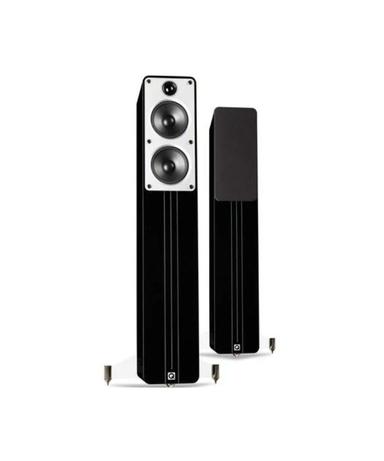
90 dB at 2.83 V · 8 Ω
45 W
per channel for 100 dB peaks
The Q Acoustics Concept 40 needs about 45 W for 100 dB peaks at 3 m
240 of the 488 amps in our catalog have enough power. Pick one to see how it does.
Stereo pair, sensitivity at 2.83 V and 1 m, open-space distance loss. Rooms add a little.
Amps
488 with speaker ratings
New amps join the list as their makers’ figures are checked.
Add your speakers and amp to your setup, and share it with the community.
Questions
How many watts do I need for my speakers?
It depends on how sensitive your speakers are, how loud you play and how far you sit. For 100 dB peaks at 3 m, the typical speaker in our catalog needs about 90 W per channel. The hungriest, the Dali KUPID, needs about 453 W. Pick yours in the calculator to see the figure for your room and level.
Is my amp powerful enough for my speakers?
It is if its rated power at your speakers’ impedance covers what they need at your peak level, with 3 dB spare, which means double the power in hand. The calculator checks 488 amps and receivers against 715 speakers and shows enough, little in reserve or falls short. Where an amp has no rating at that load, we say so.
Does doubling amp power make speakers twice as loud?
No. Doubling the power adds only 3 dB, which is a small step you can just notice. To sound about twice as loud you need roughly 10 dB more, and that takes about ten times the power. This is why a modest amp with efficient speakers can play as loud as a much bigger amp with hungry ones.
Does sitting further away need more power?
Yes. In open space each doubling of distance costs about 6 dB, which takes four times the power to win back. Moving from 2 m to 4 m, or from 3 m to 6 m, quadruples the watts you need for the same level. A real room adds some reflected sound, so these figures lean towards the safe side.
Where do the figures come from?
Speaker sensitivity and impedance come from the speaker makers, and the amp ratings from the amp makers’ own specifications. Where a maker quotes sensitivity at 1 W we convert it to 2.83 V, and where the basis is not recorded we read it as 2.83 V, which for lower impedances can only understate loudness. We do not measure anything ourselves and we do not estimate missing figures.