Which setting?
Phono gain and loading calculator
Pick your cartridge. Every phono stage in our catalog shows the gain and load to use, from the makers’ own figures.
Your cartridge
161 with figures
The pairing
MM · 5.5 mV
37.2 dB
of gain wanted
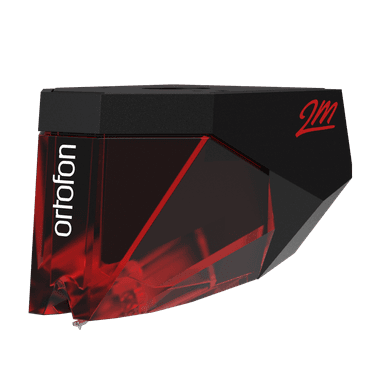
The Ortofon 2M Red puts out 5.5 mV and wants about 37.2 dB of gain
33 of the 35 phono stages in our catalog are a good match. Pick one to see the setting.
Output at the standard 5 cm/s groove speed, aiming for about 400 mV out. Loud passages run higher.
Phono stages
35 with gain figures
New phono stages join the list as their makers’ figures are checked.
Add your cartridge and phono stage to your setup, and share it with the community.
Questions
How much gain does my cartridge need?
The aim is about 400 mV at the phono stage’s output, measured at the standard 5 cm/s groove speed. Halve the cartridge’s output and you need 6 dB more gain. In our catalog the typical moving magnet cartridge wants about 40 dB and the typical moving coil about 60 dB. Pick your cartridge and the calculator works out the figure from the maker’s output, then shows which settings on each stage land close to it.
What is the difference between MM and MC gain?
Moving magnet cartridges put out a few millivolts, so their phono input adds about 40 dB. Most moving coils put out a tenth of that or less and want 55 to 65 dB. Stages label settings MM or MC to match. The calculator goes by the output itself, so a high output moving coil of 1 mV or more is steered to MM settings, or to an MC setting made for it.
What is cartridge loading?
Loading is the resistance, and for moving magnets also the capacitance, that the phono stage presents to the cartridge. Moving magnet cartridges are designed for the standard 47 kΩ input and a total capacitance their maker states, which includes the tonearm cable. Low output moving coils use a much lower load that varies from one cartridge to the next, so many stages offer several settings.
What load should I use for a moving coil cartridge?
Start with what the maker recommends. Where there is no figure, a common rule of thumb is a load at least ten times the coil’s own impedance, and the calculator labels that clearly as a rule of thumb. A lower load tends to sound slightly softer and a higher one more open, so after the starting point, trust your ears.
Where do the figures come from?
Output, coil impedance and recommended load come from the cartridge makers’ specifications, and gain and load settings from the phono stage makers’. The calculator covers 161 cartridges and 35 phono stages. We do not measure anything ourselves and we do not estimate missing figures: a cartridge or stage with no figure is simply left out.