
Pros
- Class-leading clarity
- Pristine midrange
- Massive, airy soundstage
- 24/7 comfort
Cons
- Weak bass response
- Can be too sterile or boring
- Non-removable cable
The overlooked member of the Mid-Fi Trio delivers top-tier technical skill for less money.
TL;DR
The K701 sounds bright and light on bass, and plenty of listeners call it cold, clinical or dull.
That is by design: it was built to serve the recording rather than flatter your ears.
If you want outstanding clarity and one of the widest soundstages around, there is a lot here to love.
Specs
Type: Open-back over-ear
Driver: 50mm dynamic
Frequency response: 10 - 39,800 Hz
Max input power: 200 mW
Sensitivity: 105 dB/V at 1kHz
Impedance: 62 Ω at 1kHz
Weight: 235 g (8.3 oz)
Cable: Fixed 3m
Connector: 6.3mm (1/4") gold-plated straight TRS
Release year: 2006
MSRP: $450 (reviewed at $200)
What's in the box
AKG K701 headphones
Display case box
Headphone display stand
6.3mm to 3.5mm adapter
Overview & History
AKG launched the K701 in 2006, and back then it ranked among the finest headphones available at any price you could reasonably pay. Enthusiasts of that era lumped it with two rivals, the Beyerdynamic DT880 and Sennheiser HD650, as a trio of roughly $400 performers often called the "Mid-Fi Trio".
All three remain on sale more than fifteen years later, though their fortunes have diverged, which I will come back to. AKG has since released a string of follow-ups, among them the K702, the K712 Pro and the K7XX. Even so, the original has never left production, and it has quietly picked up a few small revisions along the way as the company went through its turbulent history.
Packaging & Accessories
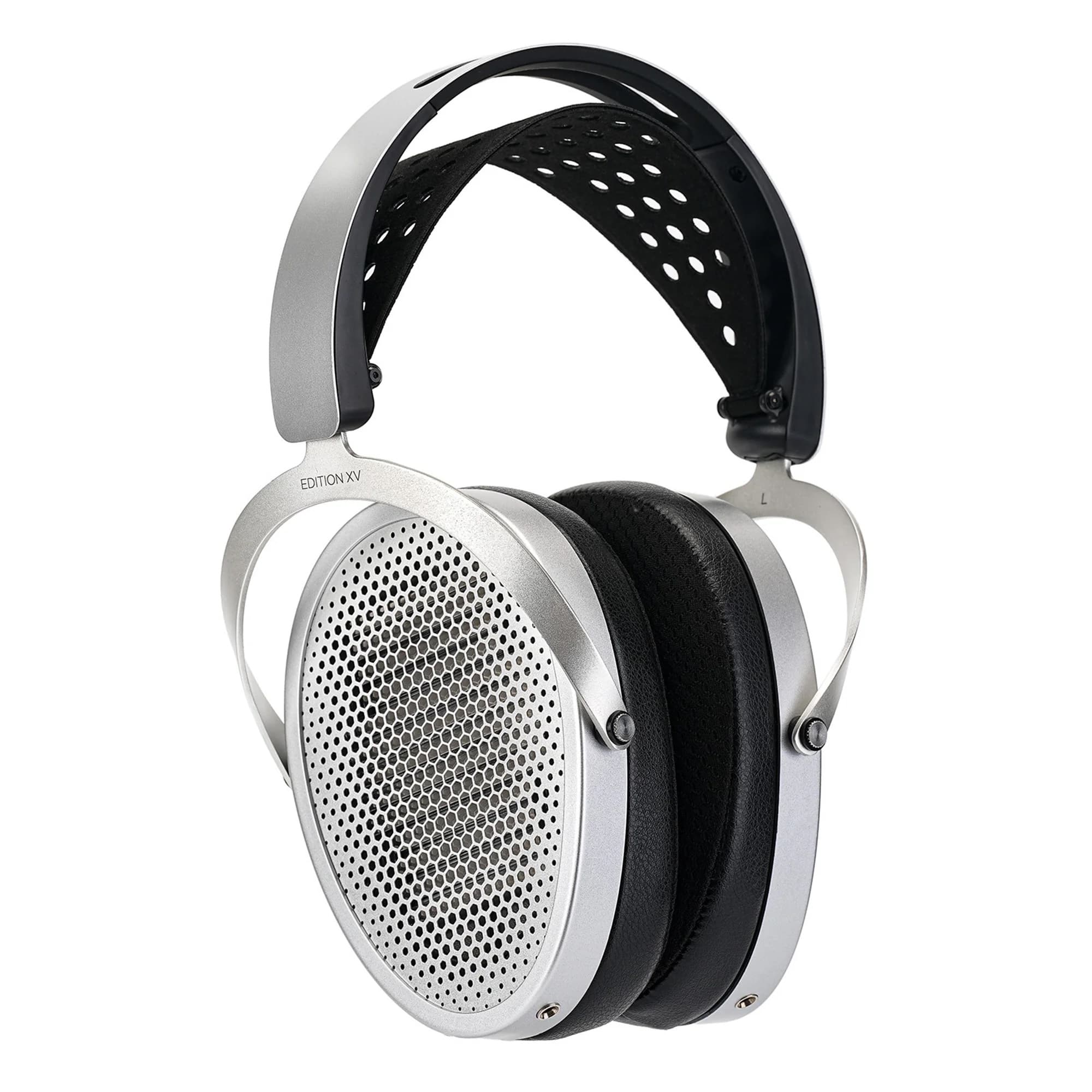
The presentation is a highlight. Newer AKG models arrive in ordinary printed cartons, whereas the K701 ships in a showy display case with a thick acrylic window. The headphones sit on a little stand inside, a charming touch that takes your mind off how little else you get with them.
Build Quality
Weighing 235 grams, the K701 is light and, you could argue, a touch fragile by the standards of premium headphones. The low weight comes from mostly plastic construction and a self-adjusting suspension headband carried over from the older K240 Monitor lineage.
Fixed plastic arches hold the earcups, while a leather strap stretches across the top of your head and is tensioned by elastic bands. With no sliding adjuster needed, there is less mass to carry.
For what it is, the quality is about right. I have noticed no creaking and no sloppy fit, and it ought to survive a few knocks and tugs on the fixed cable. It is not something to take outdoors, but at a desk or in a studio, which is what it was designed for, it is perfectly at home.
Comfort
Light to begin with, the K701 manages to feel lighter still on the head. The wide band distributes pressure evenly, and the velour pads combined with a gentle clamp keep heat from building up. I have kept them on for a full 24 hours with nothing worse than mild fatigue, if that.
One caveat is the foam inside the pads, which is quite firm and barely gives under pressure. They are comfortable all the same, but I needed a little while to get accustomed to that feel.
Sound Quality
Together, the K701, DT880 and HD650 were once viewed as the best of the professional reference class. Over time the AKG slipped in popularity, and newcomers are far more likely to be pointed towards the HD650. Since the three were seen as roughly equals, it is worth asking why that happened.
Bass
The first thing that stands out is how lean and clean the low end is. It reaches deep enough to render sub-bass without smearing, as on Nine Lives by Tennyson, but the quantity is too small for most people to enjoy with bass-heavy electronic music. As I explain further down, the rest of the tuning does little to help.
Listeners who can get past that are treated to quick, tight bass that glides through demanding low passages. Skrillex's Supersonic (My Existence) makes a good demonstration. Do I wish there were more? Possibly, but I suspect adding weight would cost the speed and definition that make these a reference.
Midrange
Clarity is the K701's main strength, and it is the principal reason I prefer it to most alternatives. The mids show it well: the lower and central regions are close to perfectly neutral, so the recording comes through plainly and without coloration. Hike by Rob Araujo is a good track for hearing that.
A small resonant lift in the upper mids gives the tone a certain airiness. Combined with the thin bass, this is what leads most people to call the sound cold or sterile. I like the tonality, myself. Other headphones in the class can resolve as much detail, but here the fine details are easier to spot.
Treble
I count the treble among my favorite aspects, though opinion on it is split. In its favor, it is crisp and bright without turning needlessly harsh, and the slim bass gives the highs plenty of space so their detail is audible, as in Contact by Daft Punk. Against it, some will find it too bright, and with so little bass to balance it that impression is harder to shake.
Soundstage
Whatever you make of the tonal balance, the staging is beyond argument: the K701 offers one of the widest soundstages around. Barring artificial surround processing, it is about as close as you can get to hearing music all around your head instead of between your ears.
Earpad Choice
Many of the photos in this review show the headphones fitted with replacement pads from Geekria. That is because pad choice really does change the sound. I compared three sets: Geekria velour, the stock velour, and Dekoni Audio Elite Hybrids.
In my experience the stock pads give the thinnest sound by far. The Geekria set sounds broadly similar, but it softens the upper mids and restores some low bass. The Dekoni pads go further and make the K701 clearly warmer.
I cannot test this under lab conditions, but I suspect the pad material and how well it seals against the head account for the differences.
To be clear, nobody should have to buy aftermarket pads to enjoy a headphone, and the K701 became my own reference exactly as it ships. Still, if you own one and find it too lean, swapping the pads may nudge it in the direction you want.
Value
As I have said throughout, the K701 is far less popular than its two old peers. The upside is that its slide behind the HD650 has made it much cheaper. All three sold for more than $400 in the 2000s, yet the K701 frequently turns up for under $200 if you shop around, while the HD650 still costs over $300.
Cheap does not mean inferior. It is a fine headphone, and the lower street price simply sweetens the deal.
Use Cases
The fixed cable, open-back construction and low weight all point to a design meant for mixing at home or in a studio. As someone who dabbles in music production and recording, I have found the bright tuning and crisp clarity extremely useful.
Being open-back, they leak sound, so I would not wear them for monitoring while recording vocals, because a condenser microphone would pick that up. They became my daily headphones the day they arrived, and soon enough I was enjoying them for everything from music to gaming.
Conclusion
Not everyone will get along with this one. The sound is so uncompromising that it puts off many listeners, who call it harsh, cold, sterile and worse.
Those very traits are what won me over, and they now set the standard against which I judge every other pair I own or will buy. If you specifically want a lean, analytical presentation, or are ready to embrace one, the K701 deserves a place on your shortlist.