
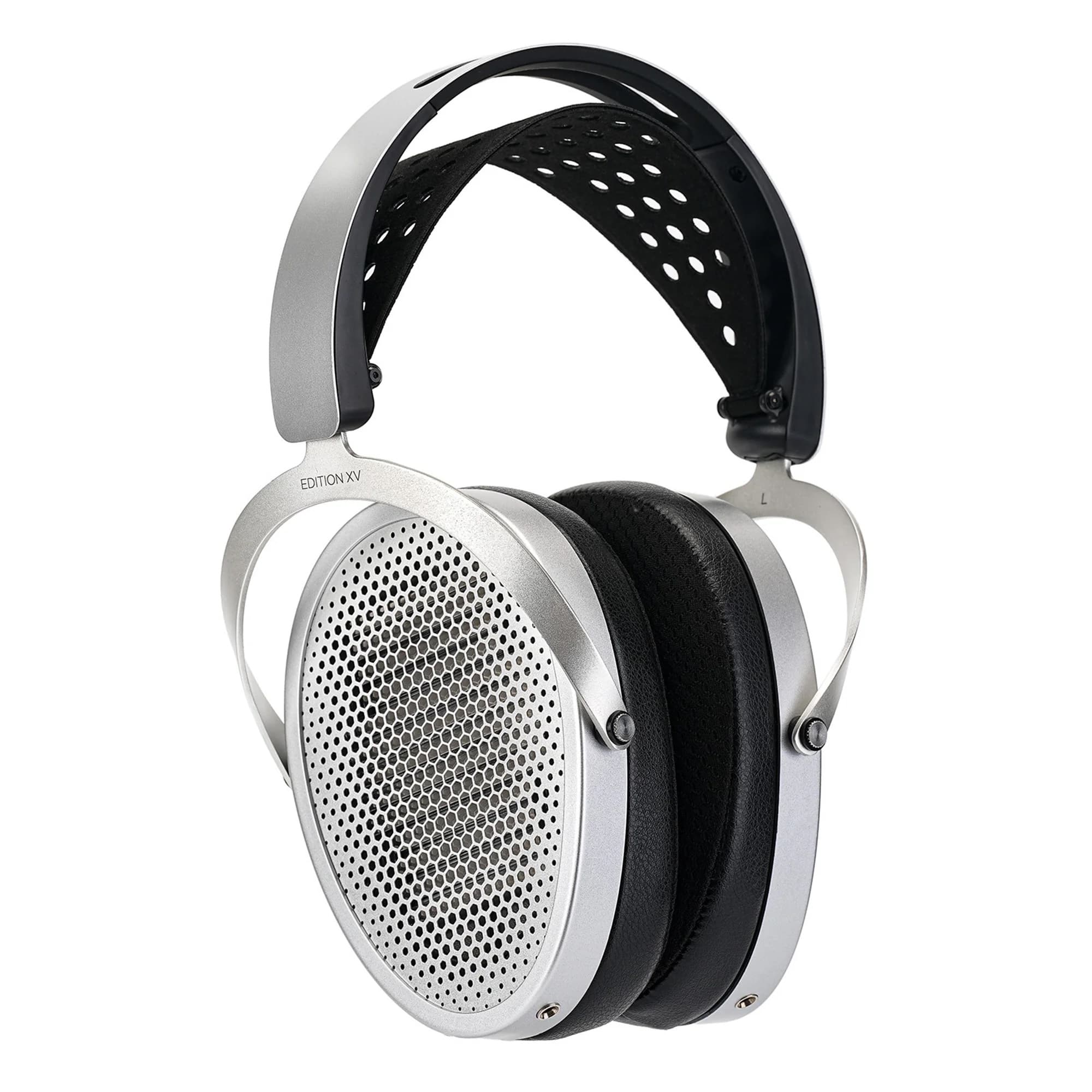
Pros
- Warm, inoffensive sound
- Smooth swivel and adjustment
- Great outdoor looks
- Excellent soundstage for portable headphones
Cons
- Earpads are small
- Lacking sound isolation (by design)
- The treble is a bit uneven
Well-built, warm-sounding portable cans held back only by a lack of noise cancelling.
TL;DR
The Fidelio L2 is a semi-open over-ear headphone from 2015, built to a high standard and pleasant to listen to.
It does almost everything a portable headphone should, though its small pads and modest isolation are real limits.
Discontinued but still available new at a fraction of its original price, it is well worth considering.
Specs
Semi-open back over-ear
40mm dynamic driver
Frequency response: 6 - 40,000 Hz
Max input power: 40 mW
Sensitivity: 93 dB
Impedance: 16 Ohms
Weight: ~260 g (without cable)
What's in the box
Philips Fidelio L2 headphones
Carrying pouch
1x cable (~1.2m)
1x cable with remote and mic (~1.2m)
A Bit of History
Philips applies the Fidelio badge to its premium consumer line: cans, earphones and home speakers. In reality the products come from Woox Innovations, a Philips subsidiary later acquired by Gibson Brands, where it remains.
The over-ear range is divided into X, L and M, while earphones fall under S and T. The L series is the premium portable tier, placed midway between the compact, light M models and the hi-fi open-backs of the X range.
Back in 2013 the Fidelio X1 generated plenty of excitement, as I recall. Its lively, bass-forward sound made it a rare open-back that actually rattled established favourites such as the Sennheiser HD600. The L1 drew far less interest, and old forum threads explain why: it cost $300, same as the X1, yet performed a little worse. That pattern carried over when the L1 became the L2, where it once more stood behind the X2HR.
First Impressions
The box is typical Philips: tidy enough, but with no premium flourish. A few restrained photos sit on the front, and the rest is packed with cluttered text and graphics. There is a pull-out inner tray and a flip-open front panel meant to add some ceremony, yet the unboxing remains plain, even at the roughly $80 I paid.
Being a portable model, the L2 includes a soft carry pouch and two cables, one plain and one with a remote. That sounds like a thin list, but the pouch and cables feel noticeably nicer than the usual extras.
Build Quality
Unboxing matters little in the end, and Philips seems to know it. The plain packaging looks like a choice to spend the effort on the headphones, and it shows.
Tough headphones often look tough. Pro audio models, with their dull matte plastic and simple construction, look unremarkable but shrug off hard use. Pretty ones usually seem fragile whatever the real build; an Audeze LCD-2 is built like a tank, but looks too lovely to knock around.
The L2 is among the few good-looking headphones I have handled that are also clearly robust, without appearing delicate. Everything feels made to last, from the crisp clicks of the headband sliders to the silky swivel of the cups.
The cables are far more supple than most fabric-covered leads, with thin internal conductors and a stretchy, paracord-like braid.
Fit and Comfort
Unlike its bigger X siblings, the L2 uses a compact over-ear layout. It is technically over-ear, but the cups and pads are sized in a way that will not suit every head.
My ears are around average, and the L2 does go around them. Still, the pads clamp snugly enough that my head starts to ache after a few hours, and they are shallow enough that my ears brush against the drivers. People with smaller ears should have an easier time, I would guess, while anyone with larger ears than mine is likely to struggle. I have also seen owners mention a pressure spot at the crown of the headband. I never felt one, though you should know it has been reported.
This is also the place to mention that the L2 is semi-open. The cups are not fully sealed, which shapes the sound but reduces isolation. That is not a flaw in itself, yet for something sold as an out-and-about headphone, letting sound leak in and out is not what most people want. Some isolation remains, but do not count on it to block out a train ride or a noisy cafe.
Sound Quality
Once you are somewhere you can really listen, the L2 performs better than almost anything else in its class. The tuning is close to a Harman balance with a warm lean, and it comes across as easy to enjoy whatever you listen to.
Bass
Low end is raised but remarkably well controlled. Instead of the usual strategy of lifting the midbass for punch, the L2 has a clear bump down in the sub-bass region, around 30 to 70 Hz. "firefly" and "I'm The Lucky One" show off that deep rumble nicely.
I suspect it is there to offset the bass loss a semi-open housing tends to cause, though it may simply be a way to broaden the appeal. Either way it is tasteful and never overdone.
Midrange
I did not hear bass spilling into the mids, although with such a warm tonality I could be mistaking one for the other. The warmth shows on a track where the voice moves between low and high registers: the low notes carry real weight while the high ones sit slightly further back.
I personally lean toward a leaner midrange, but I cannot fault how well the L2 handles it. It is clean and clear while moving from bass to treble, and I find it hard to improve on.
Treble
Relative to the Harman curve, the L2 eases the treble back a little. That helps in two ways: there is less energy to tire your ears, and the bass seems stronger without any change to the actual bass tuning.
This is the one area that is not as smooth as the rest. A few treble peaks poke through when you pay attention or have another pair as a reference. In "What Would You Do?" the vocal sibilance is softened, which is welcome, yet the hi-hats pick up a strangely uneven texture. Many listeners will never notice; I only caught it a day before writing, but it is worth recording.
Soundstage
As a semi-open design, the L2 ought to offer a wider-than-average stage, and it does. Unlike many closed headphones, it makes the music seem to come from outside your head rather than within it.
It still does not feel especially big, though. My AKG gives a touch more depth, whereas the L2 is the wider of the two. "Lovely Universe" shows it, as the two render the track's space in clearly different ways. It may be placebo or audiophile waffle, and you cannot verify it from here.
Value
Six years on from their launch, in 2023, the L2 has turned into a bargain that is hard to pass over. Production has stopped, but many retailers still carry new old stock, which gives the L2 a second life.
I got mine for about $90, shipping included. That is a long way under the launch price, and at that figure these are among the finest-sounding sub-$100 headphones, for as long as stock lasts.
Conclusion
The L2 was always a slightly odd proposition. Its competition included the V-Moda Crossfade 2 and Sony WH-1000XM2, which were wireless and noise cancelling, while the L2 was wired and semi-open. Within its own family it also had to split the difference between the featherweight M2 and the hi-fi X2HR. It truly was the middle child.
Long after release, with the last stock running out, it has a distinctive value case. I would not say rush, and soon nobody will be able to, but this is a really good pair of headphones that merits serious consideration.