

Luxman P-100 CENTENNIAL Amplifier
A fully balanced headphone amplifier from Luxman, and the first of its 100th anniversary models. Most hobbies have a ceiling somewhere, and this one keeps quietly raising it.
No members own one yet. Own one? Add it to your collection
Rating
—
be the first to rate
Owners
0
be the first
About
About the Luxman P-100 CENTENNIAL
The balanced output uses a bridge-tied load (BTL) configuration across four independent amplifier blocks, and the unbalanced output combines two amplifier circuits per channel to double the output current. There is a 6.3 mm unbalanced output plus 4-pin XLR and 4.4 mm balanced outputs. Two units can be linked through their 3-pin XLR outputs for parallel BTL balanced drive.
Volume runs through the LECUA-EX system in 200 steps of 0.5dB, shown on a 3-digit, 7-segment LED display. The LECUA-EX system also integrates three-stage sensitivity switching, left-right balance adjustment and a six-stage volume limiter.
Rated output is 4W + 4W into 8Ω unbalanced and 8W + 8W into 16Ω balanced. The main unit weighs 19.7kg and comes with a power cable.
Good for
- Headphones on 4.4 mm or XLR cables
- Pairing two units as mono amplifiers
- Listeners wanting fine 0.5dB volume steps
Specs
Technical specs
Missing: MSRP, release year and weight. Know them?
Where to buy
Shop on Amazon
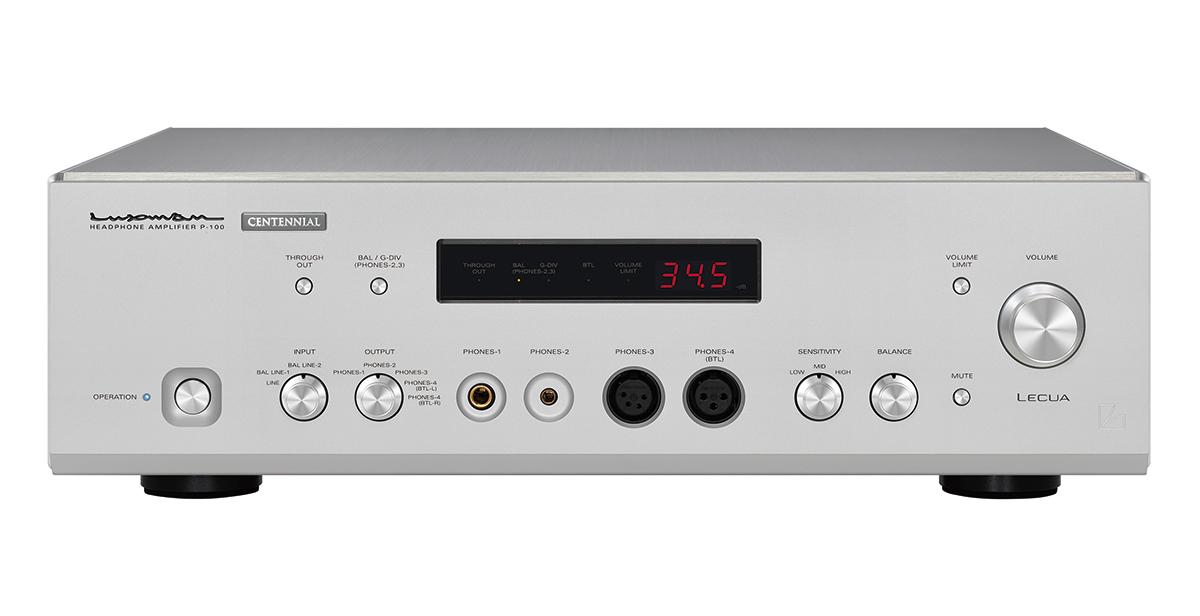
Luxman P-100 CENTENNIAL
Amplifiers
See today's price on Amazon ↗View on Amazon
As an Amazon Associate audiophila. earns from qualifying purchases.